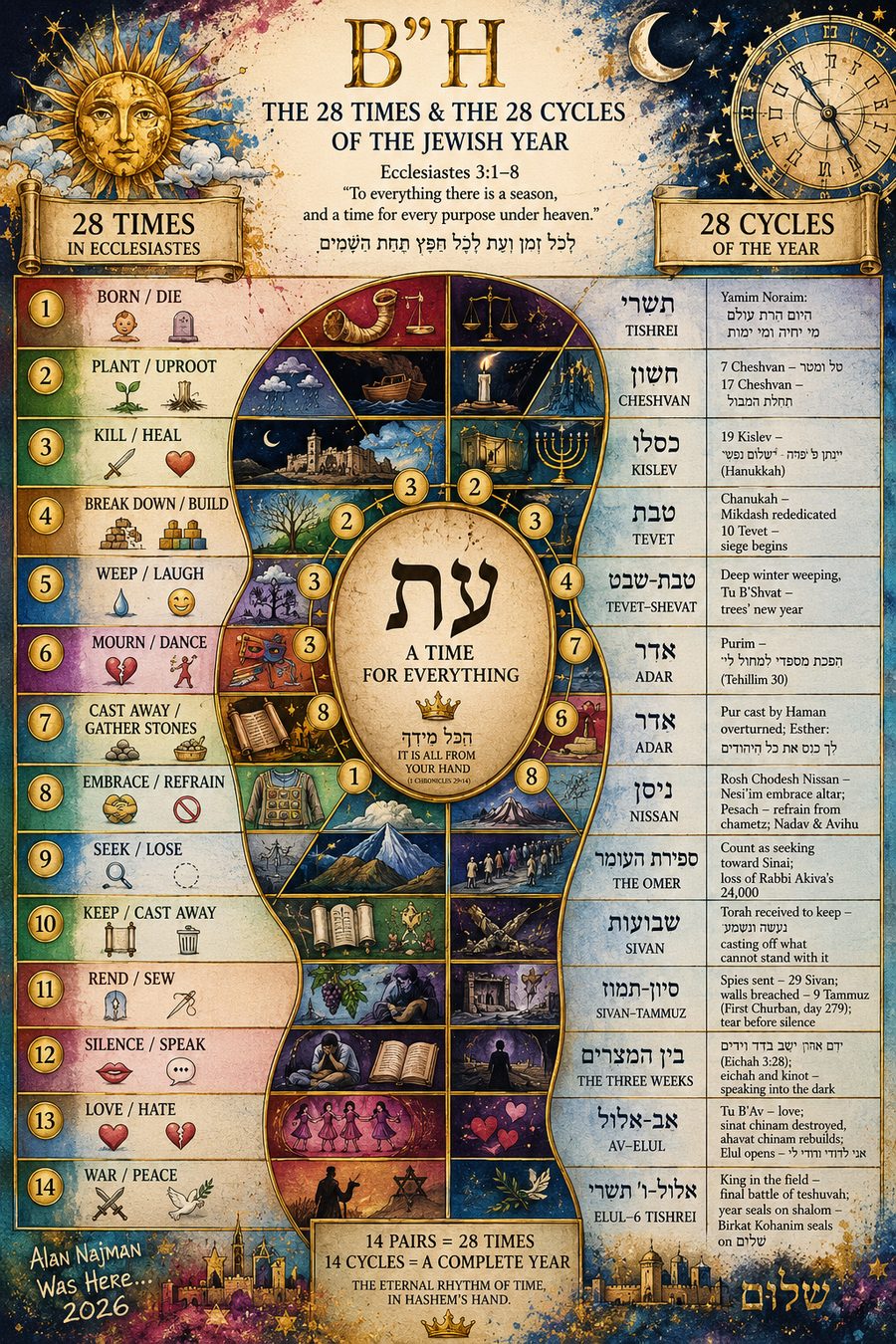
What you’re looking at. Today’s date maps onto several nested cycles at once — a day, a week, a month, a season, a year — each drawn from a different Kabbalistic or textual structure. Every card below is one of those cycles: it opens with the structure that defines it, and carries beneath it the text that structure measures. Tap a card to open it; tap the ⓘ at its top-right corner to learn what its cycle means.
Where to start. The Today’s Ladder block, just under the date. It names the next step being asked for and goes straight to it. That is enough to begin; everything below is here for when you want it.
The marks
Almost every reading wears a mark that says what it is, and the marks are what the counts are kept by. A few readings wear none — the week’s seven books in Malchut, the Zohar that stands with Thursday’s Ramchal — and those are simply read.
✦ is a counted step — light drawn inward, Or Pnimi. Beside its heading sits a gold מעלה or מיעוט tag. There are thirty of them in a day, fifteen of each, and each is marked when you have learned it.
Those two words name the two directions. A מעלה (ma’alah) is a step — a stair, a rung, something climbed. Its plural is מעלות (ma’alot): the steps, the word in Ma’alot HaZman, the spiral of the year above, and in שיר המעלות, the Songs of Ascents sung going up to the Temple. A מיעוט (mi’ut) is the opposite motion — a lessening, a making-small, what the moon does coming down.
✡ is a companion — the surrounding light, Or Makif: texts, resources and teachers that accompany the day but stand outside its thirty steps. Tap one to gather it. None of them is ever asked for by the hour or counted toward the thirty — the surrounding light does not wait on a vessel. Each one lights in the sun’s gold and fills half a star in the ring around the moon, two to a star, and a full day’s twenty-two fill the ring of eleven exactly — the eleven of Yosef’s dream: the sun and the moon and eleven stars.
One closed set among them wears a menorah rather than a star, and it is a chanukiah: ten who carry it on nine lights. The Baal Shem Tov, the Maggid of Mezritch and the Meor Einayim, and then the seven of Chabad from the Alter Rebbe to the Rebbe. Eight take the eight branches, in the order the teaching came down and from the right, as the lights of Chanukah are added; the ninth, the Rayatz, is the shamash, raised at the centre — the one whose whole work was to light others; and the tenth takes no branch of his own, because when he is gathered every light on the stand is lit. A gathered bearer lights blue and fills his own place on the menorah beside the moon.
The thirty steps
The fifteen gold מעלה tags, א׳ to ט״ו, climb from Malchut up to Keter; the moon in the clock above fills as you mark them, and at fifteen it becomes the sun, whose rays then remain. Then return: the מיעוט tags inside the cards mark fifteen steps of listening back down from Keter to Malchut, and the moon wanes as you go — a whole month walked in a single day.
What the hour asks for, then what is outstanding. Each of the thirty sits on a card, and the card has an hour, so the step being asked for is the one belonging to the Sefirah now holding the clock. Once that hour’s own reading is marked, Today’s Ladder turns to whatever is still outstanding and says catching up. This is the Baal Shem Tov’s rule for the three Psalms of Elul — say the day’s own three first, then make up what was missed — and Book 6 carries it too.
So you may tap any tag whenever you have learned it, and tap it again to give it back. Climbing the fifteen in order is a practice of its own, and a beautiful one; it is not a gate. The one thing that is: the return does not begin until the moon is full — that is direction rather than order, the light going out before it comes back. A little is a step: a few lines of the Chumash, a page opened, a shiur begun.
Tap the moon itself for Today’s Path — all thirty laid out in the order of the ladder, with the one being asked for highlighted; tap any row to jump straight to it.
The ten prayers
Each Sefirah carries one of the day’s ten prayers, in the left margin beside its hours — Hitbodedut in Keter, Shacharit in Tiferet, Mincha in Hod, Maariv in Yesod, Kri’at Shema in Malchut, and so through all ten. The one whose hour has come pulses until it is said; tap to mark it, tap again to undo. Like the thirty steps, these are marked as they are said — each prayer has its own time. The heart in Today’s Ladder fills as they accumulate, and glows when the day’s ten are whole.
The shape of a day
The climb as one practice belongs to one hour: all fifteen מעלות taken together in the Mochin — Chochmah, Binah, and Keter/Da’at — the eighty-eight minutes wrapped around Chatzot. That is the ladder, and the hour it is made for.
Each rung also has a card, and the card has an hour. So the rest of the day walks the Sefirot in turn, and every hour asks for everything that is its own: its מעלה, its מיעוט, its prayer, its ✡ companions, its Rebbe’s menorah from Chesed down. Keter’s hour holds three of the מעלות and asks for them one at a time; an hour that holds none of the readings you have undertaken moves straight to whatever is outstanding.
However you come to it. That is the ideal, and nothing depends on reaching it. The path can be joined at any hour and still be finished: the hour only says what it is asking for, and a step is marked when it was actually done, not when its hour has passed. Anyone who would rather take a single resource, or stay with one card, is welcome to — the main thing is to learn Torah and to pray as we fulfill our day’s acts of kindness. What this offers is a way to bind that learning and that prayer, and ourselves, to time, and to the beautifully intricate Kabbalistic structure found within it.
Moving around
- Use ‹ › to move a day at a time, jump to date ↗︎ for any date, and monthly calendars ↗︎ to lay a whole month out at once.
- Badges like “Week 40 · Day 4” show where you are in that section’s own cycle; the linked title beside them opens the source.
- Tap a step on Ma’alot HaZman — the spiral of the year above — for that week’s theme and teaching.
- Gevurah’s season reads Ratzo for its first forty-five days and Shov for its last — running in toward the season’s Heart on day 46, then returning out. Nothing is divided between the halves; only the direction changes. Winter’s Heart falls on Tu B’Shvat, the day the sap turns.
- Around Rosh Hashana two Kabbalah of Time years overlap; the year pills under the date switch between the one closing and the one begun. Netzach’s cycle of 369 runs five days longer than the year, so early in a cycle it offers its own toggle to reach days 365–369 of the one still finishing.
- Fixed Hours / Sha’ot Zmaniyot switches the day’s Sefirah-times between standard clock hours and halachic proportional hours for your chosen city.
- Under the title sit two settings for reading. Contrast / Soft switches between the darker, more legible grade and the warmer one; A / A+ / A++ sets the text size. Both are remembered.
- The Weekly Journal keeps the accounting: each day it reports what was actually marked — the thirty steps, the ten prayers, the companions gathered — and The Year lays all 364 days out at once, a column to a week, so nothing is lost at midnight.
The territory and the maps
The texts quoted throughout this site — Tanakh, Mishnah, Rambam, Perek Shirah — are the received tradition, and the calendar is the Jewish calendar. What is new is the mapping: the way these cycles are laid onto the year, and the patterns drawn between them and the holy texts. That arrangement is the author’s own innovation, and makes no claim to be received tradition. The territory is ancient; the maps are new.